What Content Actually Gets Cited by AI? The 11 Content Tactics of GEO, Scored
Content is the only GEO lane that works all three stages — Seen, Believed and Chosen. But AI raised the bar: it rewards information gain, not volume. The eleven content tactics, scored, sequenced, and honest about which famous one is a trap.
The short answer: content is the only lane in GEO that works all three stages at once — it's how AI finds you, how it decides to trust you, and how it closes the buyer for you — but the rules changed. Large language models are trained on the entire internet's consensus, so restating that consensus makes you invisible. The content that gets cited is the content that says something the training data doesn't already contain. Of the eleven content tactics in our library, the highest-impact one is also the slowest, the fastest one is the least trusted, and the difference between them is the whole strategy.
This is the third of four deep-dives covering every tactic in the GEO Strategy Planner's library, lane by lane: PR, Tech, Content (this post) and Brand. Every tactic below carries its real planner scores — speed, risk and impact, 0–100 — plus the KPI that proves it worked.
Eleven content tactics spanning three funnel stages is a lot to sequence by hand — the planner's board does it by score. Create a free account →
Why AI rewards information gain, not volume
The old content playbook was a volume game: publish more, cover more keywords, out-produce the competition. Generative engines broke that model in a specific way. An LLM has already read the consensus view of virtually every topic — it was in the training data. When your page repeats that consensus in fresh words, you've given the model nothing it doesn't already have, so there's no reason to cite you over the thousand other pages that say the same thing.
What breaks through is information gain: a fact, a number, an angle or a firsthand account that the internet doesn't already contain. That's why the highest-impact content tactics in the lane are the ones that manufacture new information — original research, proprietary statistics, expert interviews — and the lowest-impact ones are the ones that recombine what's already out there.
The Content lane has one more distinction: it's the only lane that plays all three stages of GEO. PR is almost entirely a "Believed" discipline; Tech is almost entirely "Seen." Content spans the whole journey — pages that get you discovered (Seen), pages that build trust (Believed), and pages that win the purchase-ready question (Chosen). That range is the lane's power and its trap: it's easy to spread thin across all three instead of going deep where it counts. The scores below are ordered by the planner's priority formula (impact-weighted, risk-adjusted) — but this is the lane where the raw score most needs reading with judgment, and the very first tactic shows why.
The 11 content tactics, scored
1. Self-published listicles
Start with the lane's cautionary tale — because the priority formula ranks it near the top, and that's exactly the lesson. Publishing "best of" lists on your own site, conveniently including yourself, is the fastest content play there is (speed 95) and it does raise presence on those topics (impact 93). But look at the risk score: 97 — the highest in the entire content lane, and near the highest on the whole 40-tactic board. Everyone, including the machines, knows who wrote a self-serving listicle. It's weakly trusted (measurability: Low), it earns "Seen" but never "Believed," and leaning on it signals a brand with nothing more credible to say. Use it as fast, cheap coverage on your own turf — never as the backbone of a plan. If your GEO strategy leads with self-published listicles, the strategy is the problem, not the tactic.
2. Answer-first retrofit of top pages
The lane's real quick win, and the first thing most teams should do. Restructure your best existing pages so the answer comes first: a summary up top, question-style headings, sections that stand on their own. That's the shape AI lifts and quotes — self-contained "chunks" it can extract without reading the whole page. No new content required, low risk, and it compounds on traffic you already earn. Retrofit your highest-value pages before you write a single new one; the fastest presence gains in this lane come from making what you already rank for machine-quotable.
3. Vs pages
Publishing your own "You vs. Competitor" comparison pages. When a buyer asks AI to compare options, you want your framing in the source material — the categories, the criteria, the honest trade-offs. Fast and high-impact, but the risk score of 77 is real and worth respecting: a comparison page that reads as a hit piece gets discounted (and can invite a rebuttal that's equally citable). The rule is fairness — represent the competitor accurately, win on the axes where you genuinely lead. Done with integrity, it's one of the strongest "Believed"-stage plays in the lane; done as a smear, it backfires.
4. Own your bottom-funnel branded prompts
The lane's clearest "Chosen"-stage tactic: owning the answers to purchase-ready questions about your own brand — "is X worth it?", "X pricing", "X alternatives". If you don't answer these, the AI assembles the answer from whoever does — reviewers, competitors, forum threads — and you lose control of the last screen before the buying decision. Moderate speed and risk, high strategic value because it sits at the point of conversion. Map your branded bottom-funnel prompts, see which ones AI currently answers without you, and publish the honest, direct pages that put you back in the frame.
5. Statistics roundup pages (maintained)
Curated, sourced pages of statistics on your topic, refreshed on a schedule. Two facts make this punch above its weight: statistics lift citation odds by roughly 32%, and stat pages are among the most-cited page formats on the entire web. Low risk, moderate speed, and a compounding asset — every refresh is a reason for the engines to re-crawl and re-cite. The catch is in the word "maintained": a stat page that goes stale is worse than none, because AI notices the dates. Commit to the monthly refresh or don't ship it.
6. Video transcripts
The lane's best effort-to-reward ratio for anyone sitting on video. AI can't watch a video — but it reads the transcript, turning knowledge you already filmed into quotable text. Speed 86, risk 9 (almost nothing to break), moderate impact. If you've got a back catalogue of webinars, talks or YouTube uploads, transcribing them is close to free information that's currently locked in a format machines can't parse. A batch afternoon's work that keeps paying out.
7. Glossary / definition hub
Own your category's definitions. "What is X?" passages are disproportionately quoted by AI — a crisp, authoritative definition is exactly the kind of self-contained chunk engines love to lift. A glossary hub also does quiet structural work: it establishes you as the entity that defines the category, which feeds the Brand lane's entity signals. Low risk, moderate everything, and durable — definitions age slowly. A strong week-two or week-three project once the answer-first retrofits are done.
8. Original research / data
The highest-impact content tactic in the lane — and the slowest (speed 12, level-4 difficulty). Run your own study, publish the numbers. Original data is a citation magnet: everyone who quotes your stat cites you as the source, and that citation carries your name into answers you'd never rank for otherwise. This is information gain in its purest form — a number that exists nowhere else in the training data. It's a quarter of work, not an afternoon, which is why it must be planned as a big bet rather than wished for. But nothing else in the content lane builds a defensible citation moat like a dataset only you have.
9. Old content update — SME interview
Refresh tired pages by interviewing your own subject-matter experts and folding in their firsthand knowledge. A stale post becomes an expertise signal — real, named human insight is exactly what "Believed"-stage GEO rewards, and it ties into the Brand lane's author-entity work. Moderate across the board, low risk, and efficient: you're upgrading existing pages rather than starting from zero. The bottleneck is expert time, so batch the interviews and let one sit-down refresh several pages.
10. Refresh zombie pages via voice
Reviving dead pages nobody visits by rewriting them with genuine voice, opinion and current information — often faster than creating new pages from scratch. The risk score of 56 is the highest among the "refresh" tactics for a reason: done lazily, it's just re-spinning thin content, which AI is increasingly good at spotting and discounting. Done well — real point of view, current facts, a reason to exist — a zombie page becomes a living asset. The dividing line is whether you're adding information or just re-arranging it. Refresh the pages worth an opinion; delete the rest.
11. Information gain
Last by the formula, first in importance as a principle — which is why it earns its own line rather than hiding inside the others. Information gain is the discipline of publishing something the internet doesn't already have: new data, a new angle, an original method. The core insight of modern GEO is blunt: repeating consensus gives AI nothing new to cite; new information makes you the source. Its modest impact score (33) reflects that "add something new" is a lens, not a single deliverable — but apply that lens to every other tactic on this list and their scores go up. The tactics that manufacture information (research, statistics, expert interviews) are simply this principle made concrete.
Prioritizing the content lane: depth beats breadth
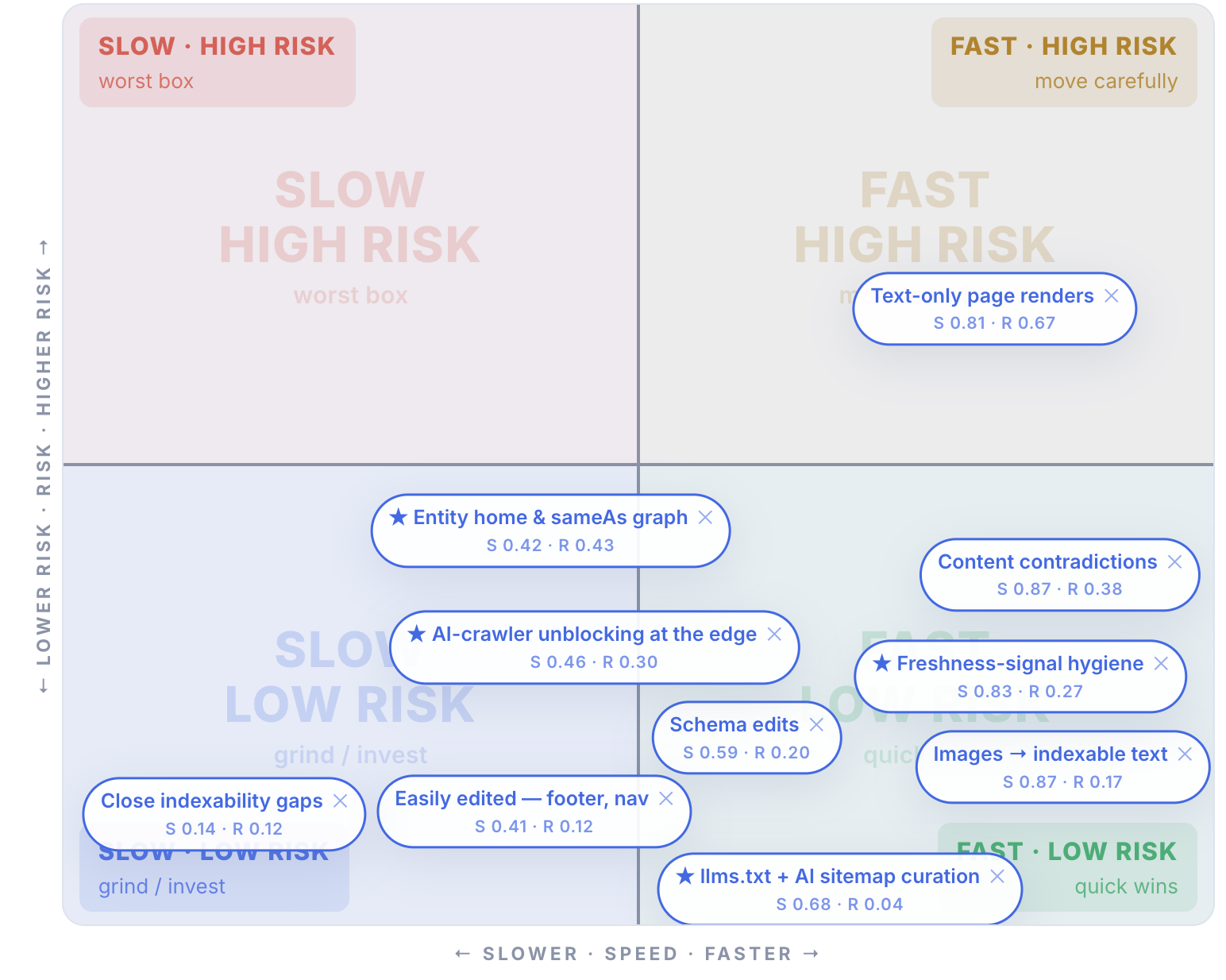
Drop these eleven on the Speed × Impact board and the lane's shape is clear: a cluster of fast, safe quick wins (answer-first retrofit, video transcripts, glossary), a set of moderate Believed-stage plays (statistics, SME interviews, information gain), one true big bet (original research — slow, level-4, highest impact), and two high-risk tactics to handle with care (self-published listicles at risk 97, vs pages at 77). Three rules fall out:
- Retrofit before you write. The answer-first restructure of pages you already own is the highest-return move in the lane — it turns existing authority into machine-quotable chunks with no new production. Do it in week one, before commissioning anything new.
- Buy one dataset. Every strong content plan needs at least one information-gain asset that only you have — a study, a proprietary statistic, an expert's firsthand method. It's the slowest tactic here and the one competitors can't copy. Commission it early because it takes a quarter to pay off.
- Distrust the fast, cheap coverage. The lane's two temptations — self-published listicles and lazily re-spun zombie pages — are fast precisely because they add no information. The risk scores (97 and 56) are the tell. Use them sparingly and never as the plan's backbone.
Eleven content tactics across three funnel stages, one big bet worth protecting, and two traps worth avoiding. Gate by your real team capacity and export the plan. Create a free account.
Start free — create your account →The one-sentence takeaway
AI cites content that adds something to the world's knowledge, not content that repeats it — so win the content lane by retrofitting what you already own for machine-quotability, then commissioning the one dataset or expert insight your competitors can't.— STRATObubbles planner library, July 2026
All scores are the planner library's July 2026 defaults, refreshed quarterly.
FAQ
What kind of content gets cited by AI?
Content that adds information the training data doesn't already contain — original research, proprietary statistics, firsthand expert insight, and clearly-structured "answer-first" pages AI can quote in self-contained chunks. Content that merely restates consensus is rarely cited, because the model already knows it.
What's the highest-impact content tactic for GEO?
Original research and data (impact 86 on our board) — publishing numbers that exist nowhere else. Everyone who quotes your stat cites you as the source. It's also the slowest tactic (speed 12), so plan it as a big bet, not a quick win.
Do statistics really help with AI citations?
Yes — statistics lift citation odds by roughly 32%, and maintained statistics pages are among the most-cited page formats on the web. The key word is "maintained": stale stat pages get discounted because AI reads the dates.
Is publishing "best of" listicles about myself a good GEO tactic?
Only as fast, cheap coverage — never as your strategy. Self-published listicles score the highest risk in the content lane (97/100) because everyone, including the models, knows who wrote them. They earn visibility but not trust.
What does "information gain" mean in GEO?
Publishing something the internet doesn't already have — new data, a new angle, an original method. Because LLMs are trained on existing consensus, only new information gives them a reason to cite you specifically. It's the principle behind every high-impact content tactic.
Lena Fischer writes about content strategy in the age of generative engines — what AI cites, what it ignores, and how to build editorial programs that show up in the answer.