GEO's Technical Foundations: The 10 Tech Tactics That Decide Whether AI Sees You
Before an AI can believe you or choose you, it has to see you. The ten technical tactics that decide whether that happens — scored, sequenced, and honestly de-hyped.
The short answer: technical GEO determines whether AI models can find, read and trust-check your site at all — and it's the opposite of PR: fast, low-risk, and mostly done in weeks, not quarters. Eight of the ten tech tactics serve the "Seen" stage of GEO, six score 65+ on speed, and the lane contains the single best bargain on our entire 40-tactic board. It also contains the two most overhyped chores in all of GEO — and knowing which is which is worth more than any checklist.
This is the second of four deep-dives covering every tactic in the GEO Strategy Planner's library, lane by lane: PR, Tech (this post), Content and Brand (coming next). As always, every tactic carries its real planner scores — speed, risk and impact, 0–100 — plus the KPI that proves it worked.
Sequencing ten technical fixes against content and PR work is exactly what the planner's board is for — create a free account. Create a free account →
Why "Seen" comes before everything else
GEO has a brutal dependency order. Authority signals (PR) and great content are worthless if the model literally cannot read your pages — and AI crawlers are worse readers than Googlebot ever was. Most don't execute JavaScript. Many get silently blocked by firewalls tuned for an older web. None of them can read a pricing table that exists only as a PNG. The Tech lane is the plumbing that makes every other lane's investment count, which is why a sane GEO roadmap clears most of it in the first month.
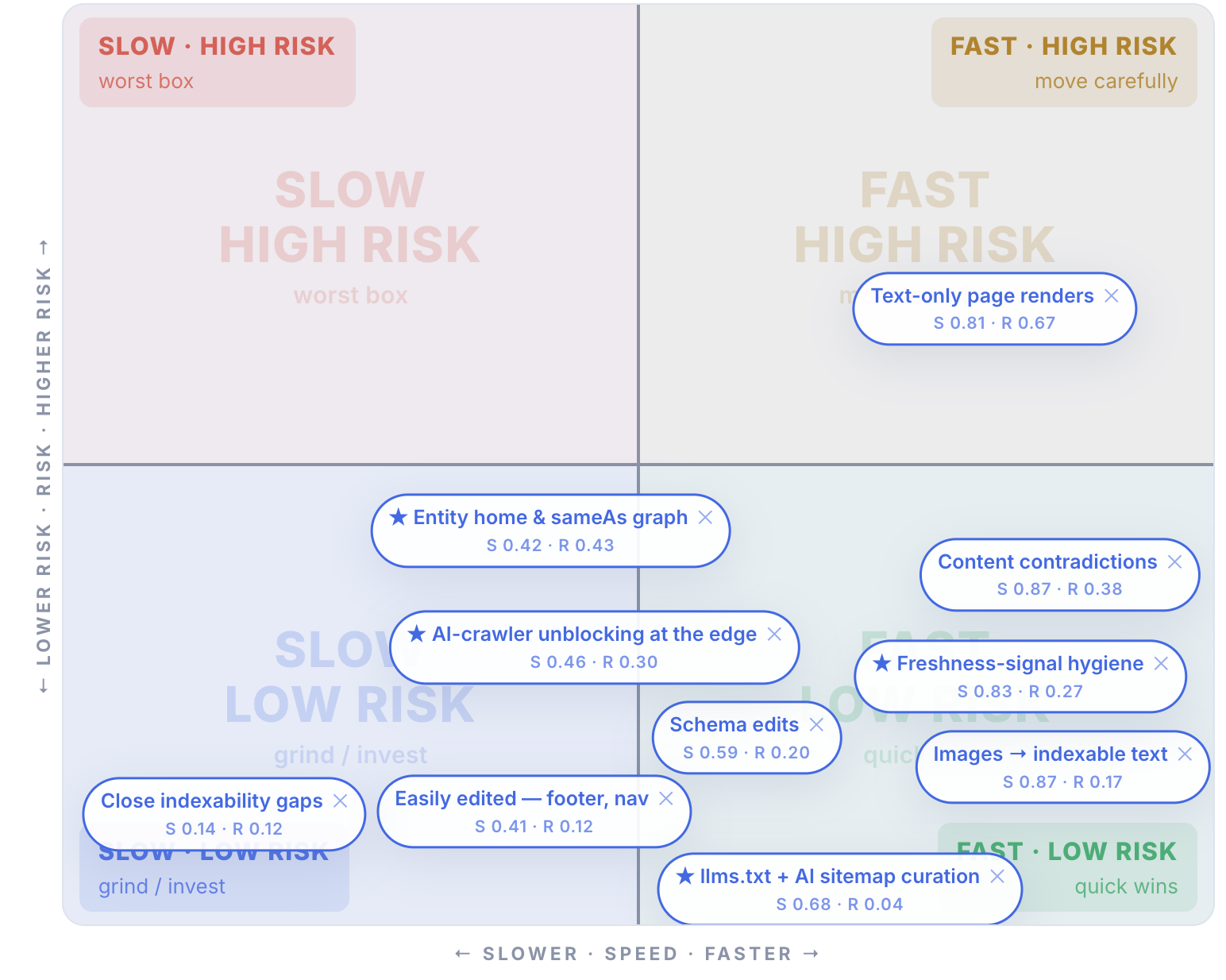
The lane's profile is the mirror image of PR's big-bet landscape: mostly quick wins — fast, low-risk, immediately measurable (nine of ten score "High" on measurability, the best of any lane). The trap is different here too: PR tempts you into risk; Tech tempts you into busywork — polishing low-impact technicalities because they're easy, while the actual blockers sit unfixed. The scores below are the antidote. Tactics are ordered by the planner's priority formula (impact-weighted, risk-adjusted).
The 10 tech tactics, scored
1. Images → indexable text
The best bargain on the entire 40-tactic board — the highest priority score of any tactic in any lane. Important information trapped inside images (a pricing table exported as a graphic, a feature comparison as a screenshot, an infographic holding your best statistics) is simply invisible to most AI crawlers. Converting those facts to real text — HTML tables, structured lists, figure captions — is same-day work with near-maximum impact. Audit your money pages first: pricing, features, comparisons. If the fact matters, it must exist as text.
2. Content contradictions audit
Find every place your own site disagrees with itself: old pricing on a forgotten landing page, a deprecated product name in the docs, two different founding years. Humans skim past these; machines can't tell which version is true, so they trust neither — or worse, confidently repeat the stale one. The fastest trust win available: a systematic sweep (search your own domain for prices, dates, product names, headcounts) usually surfaces a dozen contradictions in an afternoon.
3. Easily-edited surfaces: footer, nav, contact blocks
The fastest lever for fixing what machines get wrong about you, because it needs no one's permission: the site elements you fully control and can edit today. Footers, navigation, contact and about blocks appear on every page, so they're disproportionately represented in what crawlers ingest about your brand. Wrong address, old tagline, missing legal name? Every page repeats the error to every crawler. Get the canonical facts right once, sitewide, this week.
4. AI-crawler unblocking at the edge
The invisible blocker: firewalls and CDN bot-protection rules tuned years ago that silently serve error pages to GPTBot, ClaudeBot or PerplexityBot while human visitors sail through. From the outside everything looks fine; only server logs reveal that the AI crawlers knocking on your door are being turned away. Pull the logs, filter for known AI user agents, check their status codes — then open the door deliberately (and decide which bots you want, which is a policy question worth five minutes with leadership).
5. Entity home & sameAs graph
One canonical "who we are" page plus consistent identity links (sameAs markup pointing to your Wikidata, Crunchbase, LinkedIn and social profiles) — so every engine resolves you to the same entity. Without it, models fragment you into near-duplicates or confuse you with similarly-named companies, and every other GEO investment leaks. Do this before the deeper brand-entity work.
6. Freshness-signal hygiene
Making your update dates machine-readable and honest — dateModified on every page, visible datestamps that match reality. AI engines prefer current sources, especially on recency-sensitive prompts ("best X 2026"). Moderate impact, near-zero risk, and one strong rule: never fake it. Bumping dates without changing content is detectable and burns exactly the trust this lane exists to build.
7. Close indexability gaps
The lane's one true slow-burner: fixing the plumbing that keeps whole sections out of search and AI indexes — blocked directories, broken redirect chains, orphaned pages, missing sitemaps. Foundation work: unglamorous and essential for larger or older sites where years of migrations left debris. Small, young sites can often skip this; ten-year-old sites with three CMS migrations behind them usually can't.
8. Text-only page renders
Ensuring pages deliver their content as plain HTML without needing JavaScript to run — because many AI crawlers don't execute scripts, and a beautiful client-rendered page can arrive at the machine as an empty shell. The lane's highest risk score reflects the fix, not the goal: rendering changes (SSR, prerendering) touch core infrastructure and can break things. Diagnose first — fetch your key pages with JS disabled and see what survives. If the answer is "everything," you're done; if it's "nothing," this quietly becomes your most important tactic and deserves a proper engineering project, not a hack.
9. llms.txt + AI sitemap curation
Time for honesty: llms.txt is not an industry standard. It's a community proposal that no major AI provider has formally committed to honoring — which is why, despite being the fastest and safest tactic in the lane, its impact score is a modest 25. A curated menu telling AI which of your pages matter most: minutes of work, zero risk, uneven payoff. Ship it in week one as cheap insurance, then move on — the danger isn't doing it, it's mistaking it for a strategy. It appears on hype lists everywhere; on our board it's labeled what it is: a nice-to-have.
10. Schema edits
The second de-hype, and the more surprising one: structured data scores just 6/100 impact for AI visibility specifically. Schema is genuinely useful — machine-readable labels that make your facts easy to quote correctly, still valuable for classic rich results — but the evidence that LLMs reward it in answer selection is thin. Do it as cheap hygiene (fast, riskless), pair it with the entity work in tactic #5 where it helps most, and distrust any GEO pitch with schema at the top of the plan. If your budget forces a choice, freeing one pricing table from a PNG (tactic #1) beats marking up the whole site.
Prioritizing the tech lane: clear it fast, don't camp in it
On the Speed × Impact board this lane splits cleanly: five quick wins (images→text, contradictions, footer/nav, crawler unblocking, entity home), two low-impact fill-ins (llms.txt, schema — fast but modest, batch them in a spare afternoon), one conditional heavyweight (text-only renders — a quick check that either closes instantly or becomes a big bet), and one true big bet (indexability gaps, for sites old enough to need it).
Three rules fall out:
- Week one is tech week. Run tactics 1–4 immediately: they're fast, safe, high-impact, and everything the PR lane later earns depends on crawlers actually reading you. There is no other lane where seven days buys this much.
- Don't camp. The lane's temptation is perfectionism — endless schema tuning, llms.txt gardening. The scores say the lane's big value is captured in the first month; after that, marginal tech hours are worth less than the first content or PR hour.
- Diagnose before committing the heavyweights. Text-only renders and indexability gaps are the only expensive items — both start with a cheap diagnosis (JS-off fetch; log + sitemap audit). Let the diagnosis, not the checklist, decide whether they enter your plan.
Ten tech tactics, two traps, and a board that shows which five belong in your week one. Gate by your real team capacity and export the plan. Create a free account.
Start free — create your account →The one-sentence takeaway
Technical GEO decides whether AI sees you at all — clear its quick wins in your first month, diagnose its two heavyweights before committing, and don't let the two famous nice-to-haves (llms.txt, schema) masquerade as strategy.— STRATObubbles planner library, July 2026
All scores are the planner library's July 2026 defaults, refreshed quarterly.
FAQ
What is technical GEO?
The engineering side of generative engine optimization: making sure AI crawlers can find, fetch and read your site's content — indexability, crawler access, text-availability of key facts, entity consistency and freshness signals. It serves the "Seen" stage: everything else in GEO depends on it.
What's the highest-impact technical GEO tactic?
Freeing facts trapped in images (speed 96, risk 13, impact 94) — the best priority score on our entire 40-tactic board. Pricing tables, feature lists and statistics that exist only as graphics are invisible to most AI crawlers; converting them to real text is same-day work.
Do AI crawlers execute JavaScript?
Mostly no — many AI crawlers read only the initial HTML. If your content requires JavaScript to render, test key pages with JS disabled; if they arrive empty, server-side rendering or prerendering becomes a priority.
Does schema markup help with AI visibility?
Less than the hype suggests — we score its AI-answer impact 6/100. It remains cheap, riskless hygiene that helps machines quote your facts correctly (and supports classic rich results), but it's not a GEO strategy. Entity consistency and text-availability of facts matter far more.
Is llms.txt required for GEO?
No. It's a community proposal, not an industry standard, and no major AI provider has formally committed to honoring it. Publish one in week one as zero-risk insurance (impact 25/100 on our board), then invest your real capacity in higher-ceiling tactics.
David teaches strategy frameworks at IMD and writes for STRATObubbles on how classic models still earn their keep in the age of live data.