How Can PR Influence the Success of a GEO Strategy?
Your own website makes you findable; PR makes you believable. All ten PR tactics from the planner's library, scored by speed, risk and impact — and the strategy for sequencing them.
The short answer: PR is the single strongest lever in a GEO strategy, because large language models decide who to cite the way journalists decide who to quote — by checking what other people say about you. Your own website makes you findable; PR makes you believable. Of the ten PR tactics in our library, eight serve the "Believed" stage of GEO — more than any other lane — and they include both the highest-impact play on the entire board and its most dangerous one.
This is the first of four deep-dives covering every tactic in the GEO Strategy Planner's library, lane by lane: PR (this post), Tech, Content and Brand (coming soon). Every tactic below carries its real scores from the planner — speed, risk and impact on a 0–100 scale — plus the KPI that tells you whether it worked. The scores are opinionated defaults, refreshed quarterly; they're where your team's argument starts, not where it ends.
Planning across 40 tactics and four teams gets complex fast — the planner keeps it all on one board. Create a free account →
Why LLMs reward PR more than any other discipline
Three mechanics make PR disproportionately powerful in AI search:
- Corroboration beats declaration. An LLM answering "what's the best strategy-chart tool?" doesn't take your homepage's word for it. It synthesizes review platforms, listicles, forum threads, press coverage and knowledge bases — and recommends whoever that chorus agrees on. PR is the discipline of conducting the chorus.
- Citations concentrate on a small set of trusted surfaces. Wikipedia alone accounts for roughly 40% of ChatGPT's citations; Reddit shows up in about 21% of Google AI Overview citations; review platforms like G2 roughly triple your odds of being recommended. Getting onto those specific surfaces is classic PR work with a new scoreboard.
- The evidence gap is still open. Digital PR drives an estimated ~25% of all AI citations — while only ~6% of teams run it deliberately. That mismatch is the closest thing GEO has to an arbitrage, and it will not stay open forever.
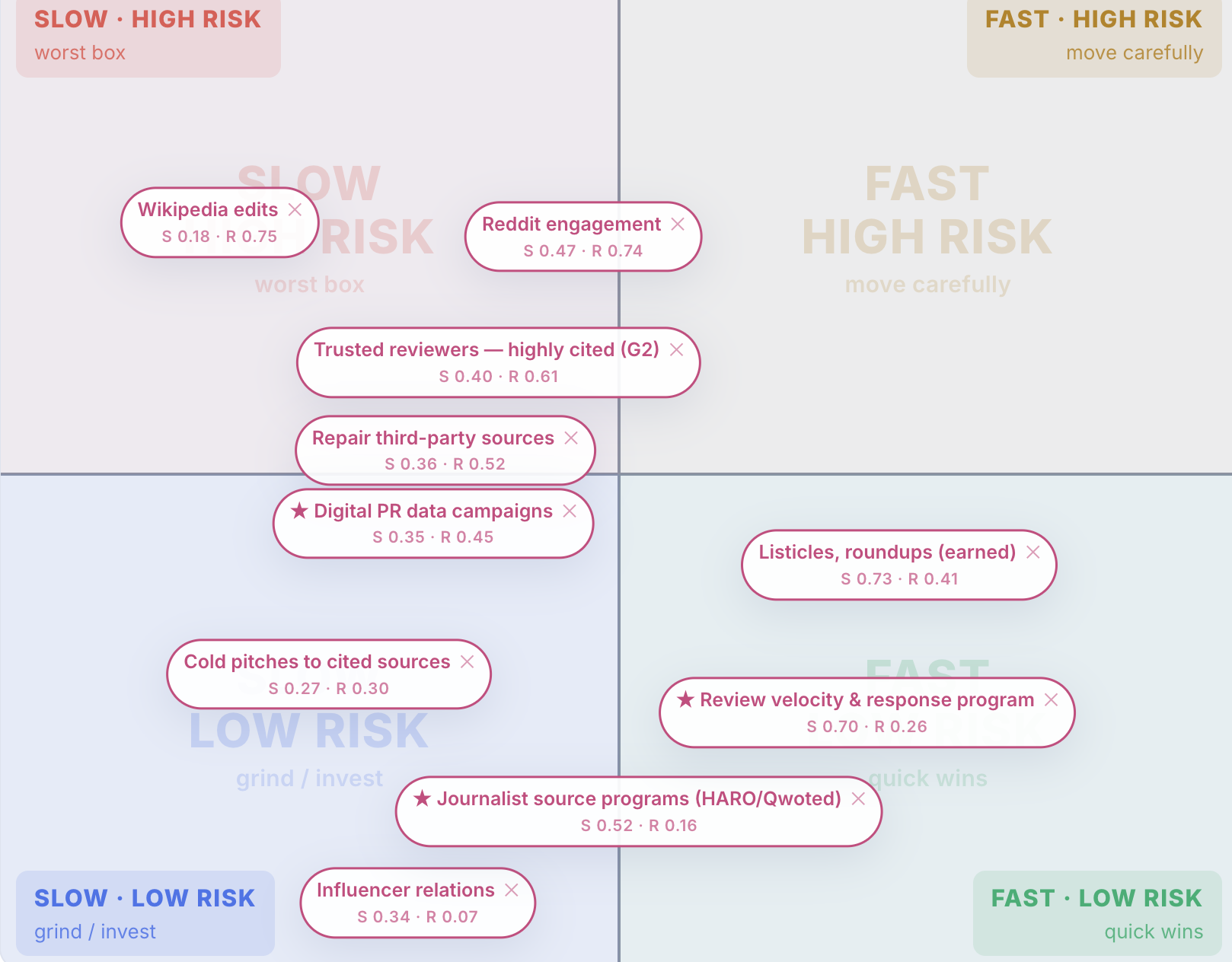
One warning before the tactics: the PR lane is slow. Nine of its ten tactics score under 50 on speed. This is the lane of big bets — high ceilings, long ramps — which is exactly why it must be planned and capacity-gated rather than improvised. Tactics below are ordered by their priority score (impact-weighted, risk-adjusted) from the planner.
The 10 PR tactics, scored
1. Trusted reviewer platforms (G2, Capterra & co.)
Getting listed — and genuinely well-rated — on the review sites AI already trusts and cites. When someone asks an assistant for "the best X for Y," the model leans heavily on structured review platforms; presence there roughly triples the chance of being recommended. The risk score reflects the loss of control: you can't dictate the reviews, and a thin or sour profile can hurt. Run it early if you have happy customers to activate; defer it if your review base is too small to survive scrutiny. Measure by asking the engines your branded and category prompts monthly and tracking recommendation quality.
2. Digital PR data campaigns
PR campaigns built around data you own — surveys, benchmarks, statistics journalists actually want to cover. This is the ~25%-of-citations / ~6%-of-teams arbitrage in action: original numbers get written about, the coverage gets crawled, and your stat starts appearing in AI answers with your name attached. Slow (a campaign is a quarter, not a sprint) and mid-risk (campaigns can flop), but it's the most repeatable high-impact motion in the lane. The KPI is concrete: count the new domains citing you after each campaign, and track how often your proprietary stat is quoted in AI answers.
3. Cold pitches to already-cited sources
Find the pages and publications the engines already cite for your topic, and pitch to be included. Classic outreach economics — low hit rate, real effort — but each win places you inside a source the model is demonstrably reading, which beats a hundred links from pages it ignores. The targeting is the tactic: build the list from actual AI answers to your target prompts, not from generic domain-authority tools.
4. Review velocity & response program
The ongoing sibling of tactic #1: actively growing review volume and answering reviews across Google, Trustpilot, G2 and industry portals. Velocity and recency are signals of a living brand; responses are signals of one that listens. Lowest-risk entry point into the whole PR lane — if the lane intimidates you, start here.
5. Reddit engagement
Genuine participation in the subreddits where your category is discussed. The prize is real — Reddit is among the most-cited sources in AI answers — but the risk score of 85 is the second-highest in the lane for a reason: communities detect and punish marketing instantly, and a public shaming thread is itself highly citable. The rule: contribute for months, disclose who you are, mention the product only when it's the honest answer to the question asked. If you can't staff sustained, authentic participation, skip it — a burned account is worse than none.
6. Journalist source programs (HARO / Qwoted)
Answering journalist requests so your experts get quoted in the press. Expert quotations lift AI citation odds by roughly 41% (the Princeton GEO study's headline finding), and this is the cheapest systematic way to accumulate them. Low risk, moderate impact — a steady background motion: thirty minutes a day of good pitches compounds into a quote portfolio.
7. Influencer & curator relations
Building relationships with the newsletter writers, YouTubers and niche curators whose content the engines cite — so your brand shows up inside what they publish. Slower than a campaign but the lowest-risk tactic in the lane: relationships rarely backfire. The targeting mirror of tactic #3: curate the list from citation data, not follower counts.
8. Repairing third-party sources
Fixing what's wrong about you on other people's sites — outdated directory entries, stale pricing in old reviews, a defunct product name in a comparison post. AI reads those sources; if they're wrong, the AI is confidently wrong about you, forever. Unglamorous — but for older brands with a long paper trail, this is often the fastest accuracy win available.
9. Wikipedia edits
The most extreme bubble on the entire board: near-maximum impact (Wikipedia feeds roughly 40% of ChatGPT's citations) and near-maximum risk — the highest in the library. Wikipedia's community rules prohibit self-interested editing; clumsy attempts get reverted, flagged, and permanently logged in a talk page the models can also read. The playbook is patience: fix genuine factual errors transparently via talk-page requests, supply reliable third-party sources (which the rest of this lane generates), and never touch promotional language. Handle with care is not a caveat here; it's the tactic.
10. Earned listicles & roundups
Getting into other people's "best of" articles — the raw material from which AI assembles most "what's the best X?" answers. The lane's only genuinely fast tactic, and the lowest-impact of the ten because a single listicle mention is a drop in a large pool. Treat it as a volume play attached to tactic #3's outreach list, not a standalone strategy.
Prioritizing the PR lane: mostly big bets, by design
Drop these ten on a Speed × Impact board and the pattern is unmistakable: eight of ten land in Big Bet territory (slow, high-impact), one is a fill-in (earned listicles), and none — none — is a true quick win. That's the strategic identity of the lane, and it dictates three rules:
- Never build a GEO plan that is only PR. You'll show nothing for a quarter. Pair 2–3 PR big bets with quick wins from the Tech and Content lanes so the plan has visible momentum while trust compounds.
- Sequence by risk appetite, not just impact. A sane on-ramp: review velocity (risk 25) → journalist programs (20) → influencer relations (14) → then the heavy artillery: data campaigns, the G2 push, Reddit — and Wikipedia last, if ever, once your third-party source base can support every claim.
- Respect the capacity gate. Four of these tactics demand a senior team (data campaigns, influencer relations, source repair, Wikipedia). A plan you can't staff isn't a plan.
This is where GEO planning gets genuinely complex. The planner puts all of it on one drag-and-drop board, gates it by your real capacity, and exports the plan your client or board actually understands.
Start free — create your account →The one-sentence takeaway
PR influences GEO success more than any other lane because LLMs are corroboration machines: they recommend whoever the trusted third-party record agrees on — and PR is the discipline of building that record deliberately.— STRATObubbles planner library, July 2026
All scores are the planner library's July 2026 defaults, refreshed quarterly.
FAQ
Why does PR matter for GEO / AI search visibility?
Because LLMs weight third-party corroboration over self-description: they cite review platforms, press, forums and knowledge bases. PR is the discipline that shapes those sources — eight of the ten PR tactics in our library serve the trust-building "Believed" stage of GEO.
What is the highest-impact PR tactic for GEO?
By raw impact, Wikipedia edits (95/100) — but at 96/100 risk. Weighted for risk and speed, trusted-reviewer platforms (G2/Capterra) and digital PR data campaigns are the strongest plays; presence on major review platforms roughly triples AI recommendation odds.
How fast does PR work for AI visibility?
Slowly — nine of ten PR tactics score under 50/100 on speed. Plan PR as compounding big bets over quarters, paired with faster tech and content tactics so the overall plan shows early results.
Should I edit our Wikipedia page for GEO?
Only via transparent talk-page requests to fix genuine factual errors, backed by reliable third-party sources — never promotional edits. It's the riskiest tactic on our 40-tactic board; a botched attempt is permanently visible.
How do I measure PR's effect on GEO?
Per tactic, via its leading KPI: newly AI-cited referring domains, recommendation quality on branded prompts, quote pickups, presence in community-sourced answers, and brand-accuracy rates on third-party sources. Track your target prompts monthly across ChatGPT, Perplexity and AI Overviews.
Sara spent a decade as a strategy consultant at a top-tier firm before joining STRATObubbles. She writes about the tools senior teams actually use to make portfolio decisions.