How to Build a GEO Strategy for 2027 (and Beyond)
A step-by-step framework for turning 39 known AI-search tactics into one prioritized, capacity-gated plan — and proving each move moved a metric.
Building a GEO strategy means deciding which AI-search tactics to run first — and then proving they moved a metric. The fastest way to get there is to plot every tactic by speed, risk and impact, gate it by your team's real capacity, and sequence what survives into a dated roadmap.
That's the whole job, and it's harder than it sounds. The tactics themselves aren't the mystery — llms.txt files, schema, entity graphs, digital PR, original research, YouTube, Wikidata, answer-first content are all well documented. The hard part is deciding what to do first with the team you actually have, and tying each move to a number you can show a client or the board. With ChatGPT now handling around 2.5 billion prompts a day — roughly two-thirds of them search-like — going into 2027 without a plan for AI visibility isn't really an option.
This guide gives you a repeatable framework for doing exactly that, plus a free template with 39 tactics pre-scored and mapped to KPIs.
What is a GEO strategy (and why GEO ≠ SEO ≠ AEO)?
Generative engine optimization (GEO) is the practice of shaping your content, entities and reputation so large language models cite and recommend your brand in their answers. A GEO strategy is the prioritized, capacity-aware, measurable plan for getting there.
It helps to separate three overlapping disciplines:
| Discipline | What it does |
|---|---|
| SEO | Ranks your pages in classic search results — still the foundation everything else builds on. |
| AEO | Answer engine optimization — gets you selected for AI-powered answers like Google AI Overviews. |
| GEO | Gets your brand cited and recommended inside LLM answers from ChatGPT, Gemini, Perplexity and Claude. |
The three reinforce each other, and a real GEO strategy spans all of them. Treating GEO as a bolt-on to SEO is the first mistake; treating it as a replacement is the second.
Why most GEO "strategies" fail
Most GEO plans are really just tactic lists, and they fall apart in three predictable ways:
- Everyone disagrees. Ten tactics, ten opinions, and no shared way to weigh speed versus risk versus impact.
- Slides go stale. A static deck can't keep pace with an AI-search landscape that shifts monthly.
- No proof it worked. Tactics get marked "done," but nothing ties them to a metric you can put in front of a client or an executive.
A strategy isn't a list of things to do. It's a prioritized, capacity-aware, measurable sequence — and that's what the rest of this guide builds.
The framework: Seen → Believed → Chosen
Every GEO tactic serves one of three goals. Ordering your work along these stages is what turns a pile of tactics into a strategy. (The framework is open; we extended it by wiring every tactic to a measurable KPI.)
- Seen — the model can find and parse you. Technical and content foundations: schema, llms.txt, entity graphs, indexability, answer-first pages.
- Believed — the model trusts you. Authority and corroboration: original research, digital PR, reviews, citations, expert quotes.
- Chosen — the model recommends you over rivals. Differentiation and coverage: branded-prompt ownership, freshness programs, knowledge-graph presence.
Knowing which stage a tactic serves tells you what it's actually for — and stops you from, say, chasing "Chosen" differentiation before the model can even reliably "see" you.
The 39 tactics — your GEO library, organized
A GEO strategy draws from a library of tactics grouped into four capacity lanes. These are the raw material; the strategy is how you sequence them.
- Content — answer-first retrofits of top pages, glossary / definition hubs, statistics roundup pages, "vs" pages, original research, video transcripts.
- Tech — schema edits, llms.txt + AI-sitemap curation, entity home & sameAs graph, images-to-indexable-text, closing indexability gaps, freshness-signal hygiene. (Deep-dive: GEO's technical foundations — all 10 tech tactics scored.)
- PR — digital PR data campaigns, journalist source programs (HARO/Qwoted), earned listicles and roundups, trusted-reviewer placements, review-velocity programs. (Deep-dive: how PR influences GEO success — all 10 tactics scored.)
- Brand — author-entity building, YouTube channel programs, Wikidata & knowledge-graph claims, founder-story and values content, GTM message congruence.
Every tactic in the template carries a leading KPI and the module that measures it — so "done" always maps to a number. Knowing 39 tactics is easy. Knowing which six to run this quarter, with the team you have, is the strategy.
How the 39 tactics map your GEO plan for 2027 and beyond
Here's the repeatable method that turns the library into a dated roadmap. This is the part that actually answers "how do I build a GEO strategy?"
Step 1 — Set your team's capacity
Rate your real capacity across the four lanes — PR, Tech, Content, Brand. Any tactic you can't staff drops off the board. This one step is what separates a wish-list from a plan: a brilliant digital-PR campaign you have nobody to run isn't a strategy, it's a fantasy.
Step 2 — Score every tactic on two boards
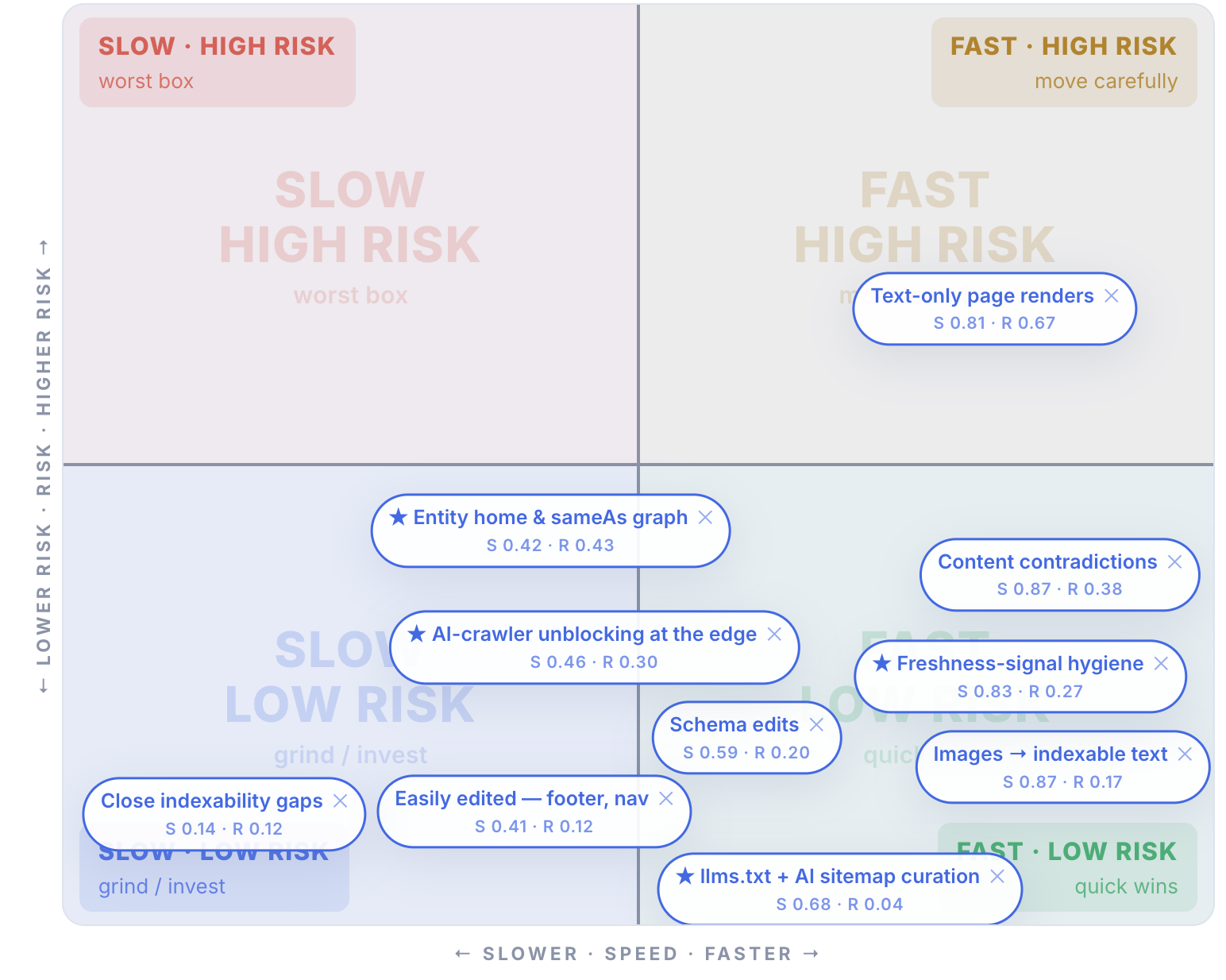
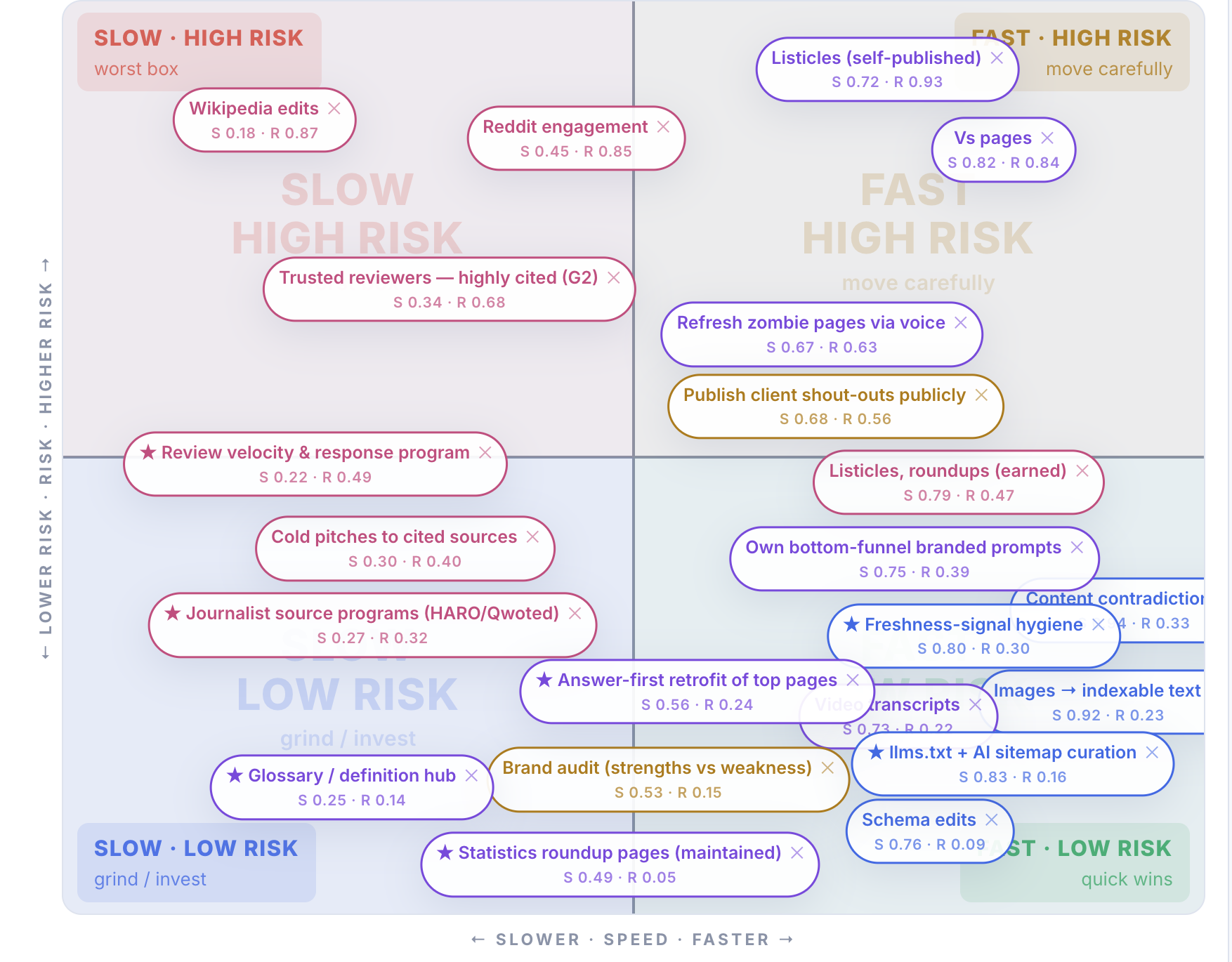
Plot the surviving tactics on Speed × Impact and Risk × Impact. Four quadrants fall out naturally:
- Quick wins — fast, high impact → do now.
- Big bets — slow, high impact → plan and resource.
- Fill-ins — fast, low impact → batch when the team has slack.
- Money pits — slow, low impact → cut or defer.
Step 3 — Sequence into a 2027 roadmap
Turn the quadrants into a timeline mapped to Seen → Believed → Chosen:
- Now / Q1 2027 — foundations (Seen). Schema, llms.txt, entity graph, answer-first retrofits — the low-risk technical and content work the models need before anything else pays off.
- Next / H1 2027 — authority (Believed). Original research, digital PR, review velocity, glossary and statistics hubs — the tactics that build the trust and corroboration LLMs weight most.
- Later / H2 2027 and beyond — differentiation (Chosen). YouTube, knowledge-graph claims, sustained freshness programs — the compounding bets that make the model pick you.
Step 4 — Attach a KPI and export the plan
Every tactic is already tied to a metric — AI share of voice, citation frequency, visibility score. Export a client- or board-ready plan so the strategy is defensible, not just a slide.
The 39 items barely change year to year. Your capacity, your scores, and your sequence do. Re-run the board each quarter and the same library produces a fresh, defensible plan for 2027 and every year after.
Your free GEO strategy template
This entire method ships as a free template: 39 tactics pre-loaded, each scored on speed, risk and impact and mapped to a KPI, on the Seen → Believed → Chosen framework. You set your capacity, drag to prioritize, and export the plan. Three moves — capacity, prioritize, export — and you have a roadmap instead of an argument.
GEO strategy best practices for 2027
- Gate by capacity before you prioritize — an un-staffable tactic isn't a plan.
- Tie every tactic to a KPI, or you can't prove it worked.
- Lead with Seen-stage foundations; authority and differentiation don't compound without them.
- Add expert quotes, statistics and citations to your own content — the Princeton GEO study found a +41% lift in AI visibility from expert quotes, with stats and citations adding roughly 30% each.
- Re-score quarterly; AI search shifts monthly, so a static plan is already stale.
FAQ
How do I build a GEO strategy?
Score every AI-search tactic by speed, risk and impact, gate the list by your team's real capacity, sequence what survives into a roadmap along the Seen → Believed → Chosen stages, and attach a KPI to each move so you can prove it worked.
What's the difference between GEO, AEO and SEO?
SEO ranks your pages in classic search results. AEO gets you selected for AI answers like Google AI Overviews. GEO gets your brand cited and recommended inside LLM answers from ChatGPT, Gemini, Perplexity and Claude. They reinforce each other.
How many GEO tactics are there?
The template ships with 39 core tactics across content, tech, PR and brand. The skill isn't listing them — it's sequencing the right handful for your team and stage.
Do I need to be a GEO expert to build a strategy?
No. The template comes with every tactic pre-scored and mapped to a KPI, so you prioritize and present rather than start from a blank page.
How often should I update my GEO strategy?
Quarterly. Re-run the board as your capacity changes and the AI-search landscape shifts.
Sara spent a decade as a strategy consultant at a top-tier firm before joining STRATObubbles. She writes about the tools senior teams actually use to make portfolio decisions.